

Enno Hallek
“The Colours of Rohuküla”
13.11 - 31.12
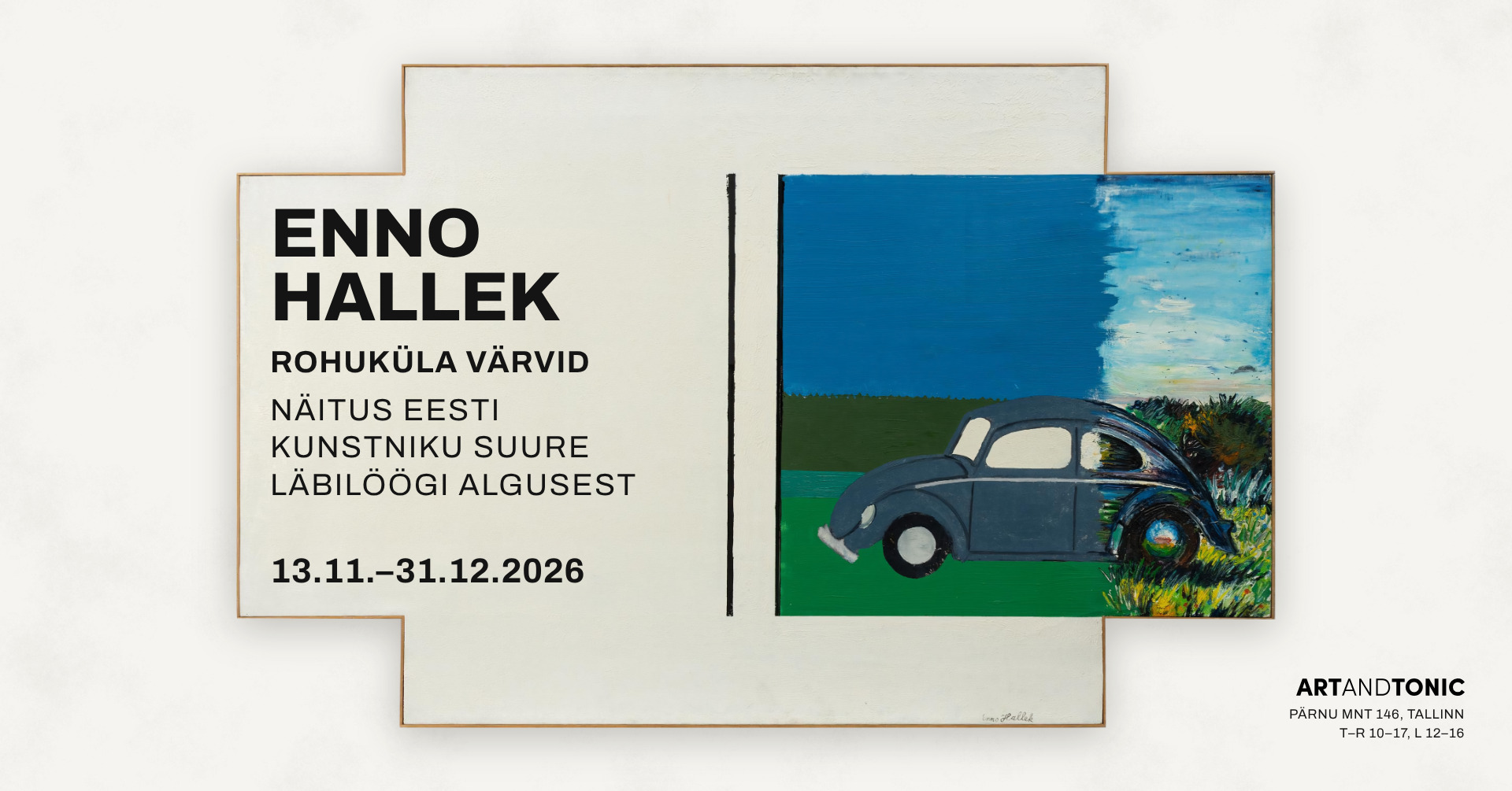
You cannot pack a sunset into a boat. Yet Enno Hallek carried the sky of Rohuküla with him, painting its colours for more than half a century.
This year marks 95 years since the birth of Enno Hallek, while the first anniversary of his death falls at the end of the year.
The artist, originally from Läänemaa in Estonia, brought Pop Art to Sweden, designed one of Stockholm’s best-known metro stations and headed the painting department at the Royal Institute of Art in Stockholm for many years. The exhibition focuses on his earlier work, dating back to the mid-1950s and early 1960s, when Hallek created some of his iconic pieces.
Hallek grew up in Rohuküla, near Haapsalu, as the son of a fisherman. When his parents were out trawling at sea, they would tie the boy to the mast with a rope to keep him out of harm’s way. To keep him occupied, they placed a tub of water filled with wriggling fish in front of him. “I have seen many rainbows and sunsets; they are part of my childhood,” Hallek once said. These images became his first artistic experiences.
In 1943, the family fled across the sea in their fishing boat. They could take only the essentials. His father grabbed a pair of oars before they left. Thirty years later, those very oars became the cornerstone of one of Hallek’s most famous works, and one of the best-known works of Estonian art created in exile.
Between 1953 and 1958, Hallek studied at the Royal Institute of Art in Stockholm and held his first solo exhibition in 1963. He entered the art world with such force that he became one of the pioneers of Scandinavian Pop Art. Unlike American Pop Art, he was not interested in consumer culture or advertising. His motifs included hands, windows, fish, oars, saws, mirrors and sunsets, complemented by patterns drawn from Estonian folk art. His life-size self-portrait, The Christ Complex (1961), was so daring at the time that people were reluctant to exhibit it publicly.
Ever since his student years, Hallek had been searching for something that existed between painting and sculpture. He began by sawing rough fish shapes out of wood and painting them in vivid colours. In the mid-1960s, he started depicting landscapes that seemed to be knotted together, with colours compressed and bound by ropes. In the 1970s, his works grew into large-scale objects, cut out of wood and painted over, extending beyond the frame and into the surrounding space.
The masterpiece of this period is My Oars from Estonia and Memories (1975). Consisting of ten painted oars, the work is part of the collection of Moderna Museet in Stockholm, where Hallek’s art is displayed alongside works by Andy Warhol and Pablo Picasso.
Two years earlier, Hallek had completed his best-known public artwork. Together with Åke Pallarp, he designed Stockholm’s Stadion metro station, painting a large rainbow across the exposed rock face and introducing distinctive wooden objects into the space. They were the first artists bold enough to leave the cave’s natural rock surface exposed, and their vision transformed the concept of the entire metro line.
In 1975, Hallek was elected a member of the Royal Swedish Academy of Fine Arts. From 1981 to 1991, he was Professor of Painting and Head of the Department of Monumental Art at the Royal Institute of Art in Stockholm. He became one of the most prominent internationally recognised artists of Estonian origin.
For decades, however, his ties with his homeland had been severed. He returned to Estonia for the first time in 1989, and the following year the Estonian Art Museum organised his first solo exhibition in Estonia at Kadriorg Palace. The artist’s final wish was for the works inspired by his childhood in Rohuküla to find their way back to Estonia.
This exhibition reveals where it all began. There is an extraordinary amount of energy in great art.