

Maarit Murka
“Ibaesene”
16.01 - 28.02
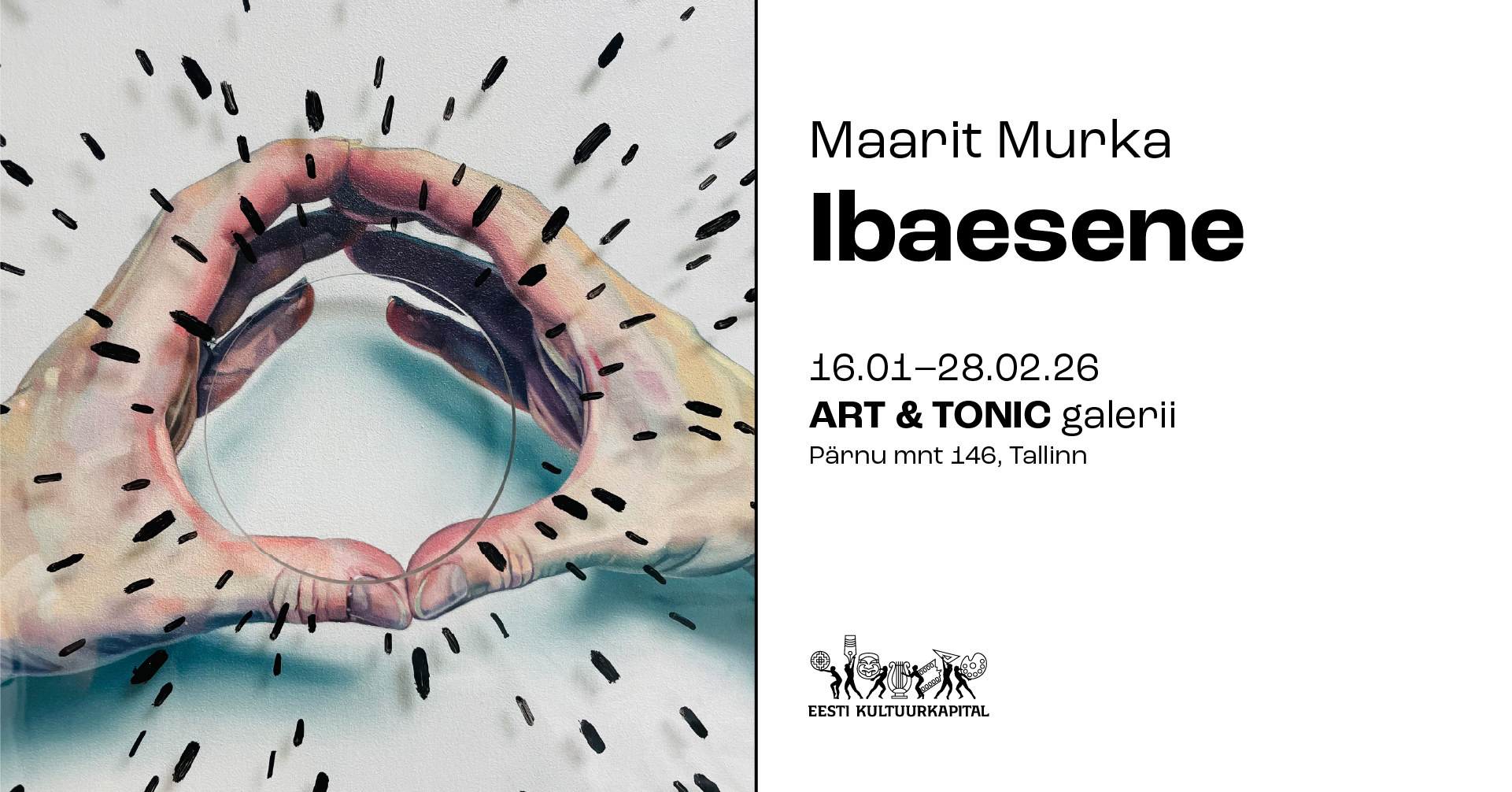
“Ibaesene” spelled backwards is “eneseabi” (“self-help”). Self-help is not about fixing oneself, but about a way of remaining functional in a world that places strain on the nervous system. In psychology, self-help is referred to as self-regulation that is, the ability to notice when internal tension is increasing and the skill to alleviate it before it becomes paralyzing.
For artists, the relationship with self-help is much broader and more complex, because creativity does not arise out of nothing. It requires emotional and mental resources. In art, it is normal to be in doubt, to be vulnerable, or to live in a constant inner dialogue. An artist is accustomed to observing and expressing their inner world and, through creativity, giving form to feelings that are difficult to express directly. At the same time, creative work is characterized by vague goals, constant self-evaluation, and the artist’s own identity being closely tied to the outcome.
From the outside, it may seem that self-help comes more easily to artists than to others. They are used to observing their inner world and shaping it. Emotions are neither foreign nor forbidden to them, and confusion does not immediately signify failure. The creative process resembles therapy in many ways, as both require presence, a search for meaning, and the shaping of experience. Yet this similarity is deceptive, because the need to be an artist may include the temptation to use one’s difficulties against oneself. This is reinforced by the desire to turn pain into identity, and personal suffering may become fuel for creation. Something that is hard to relinquish. Herein lies the paradox. An artist may have more languages with which to speak to themselves, but also more ways to avoid direct self-care. Pain can become material, and restlessness part of one’s identity. The cultural myth of the suffering artist provides a silent justification for all of this.
This exhibition, too, has been born out of a similar duality. Like countless previous ones and those yet to come—regardless of where in the world they are created, and whether by experienced or unrecognized artists. One might call this an artistic nature, which on the one hand involves exposing deeply personal experiences and on the other hand entails unceasing doubt about the necessity of doing so.
Maarit Murka describes these poles along her own path as follows:
“I am constantly engaged in trying to understand who I am, why I am, and where I am. I have tried many times to slip away from this path, but I am always placed back onto it. So this is my place and my road. It is not easy, but I do not want to abandon it either. You can cry if you want, but you still go and do it, and in the end you are happy and content, even though during the process the path seems winding and endless. I don’t really know where my images come from. They just come. Over the years, I have stepped away from directly inventing them. Visuals appear to me randomly, which I later analyze. That is why I must complete the work I have undertaken in one continuous stretch, because half a year later it is already a new time, with new visuals whose analysis leads to a completely different place than today. If I were to sum up what connects these states of coping, it would be a borderline situation of asking for help and the attempt to find oneself and manage while standing on that edge. How does a person position themselves when things are difficult? For years now, I have been mulling over the conviction that I embed some strange energy into my works. That same energy drains me during the process and later, once the work is finished, gives everything back again. Like a power bank. For me, the current works are very different from what I have done before. At the moment, I cannot yet say why. It simply feels different. Although their creation has at times been inexplicably difficult, I cannot use details or words with a negative undertone to describe it cause something seems to prevent me. The phrase ‘what doesn’t kill you makes you stronger’ applies to these works, but because the word ‘kill’ is in it, I cannot use it. In addition, with these works I have sensed and noticed that someone else is present in them. I don’t know whether this feeling seeps in from my surroundings or from the frighteningly widespread talk about the impact of artificial intelligence on art, but when things are difficult for me, I always, for some reason, turn toward God or something greater. When I think about it, it has always been present. I remember already from the end of high school that the characters in my essays were God’s legs and other body parts. Strange, isn’t it?”